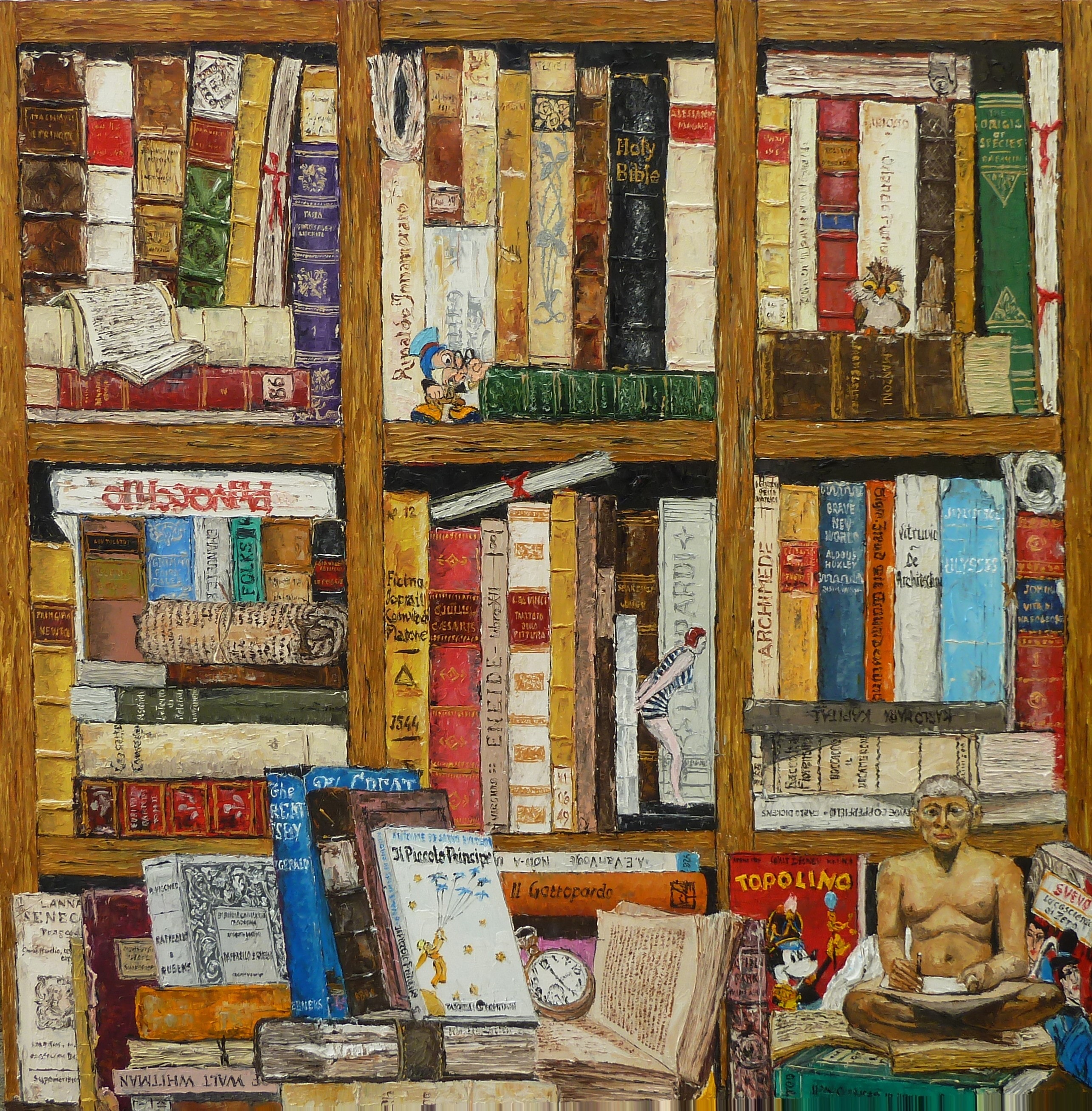
The tale of Ulysses' last voyage - vv. 85-142
The greater of the two flames then begins to move as though stirred by the wind, and from the movement of the tip of that tongue of fire words begin to come forth.
Ulysses does not introduce himself and starts at once to speak of the last years of his life, from his farewell to the sorceress Circe: here Dante takes over word for word the lesson of Ovid who, in the Metamorphoses XIV 436 ff., has Macareus, one of Ulysses' companions, tell Aeneas how he abandoned his captain, who was once again putting out to sea.
After a year at Gaeta (before Aeneas gave the place that name), «né dolcezza di figlio, né la pièta / del vecchio padre, né 'l debito amore / lo qual dovea Penelope far lieta» – neither fondness for his son, nor pity for his aged father, nor the love he owed Penelope, which should have made her glad – could hold Ulysses back from his thirst for knowledge, from his burning desire to know human vices and human worth. And so he set out for the open sea instead of going home, with one ship and that «compagnia picciola», the small company of always. He sailed along the European shores (as far as Spain) and the African ones (as far as Morocco) of the western Mediterranean, including such islands as Sardinia and the rest. He and his companions were already old when they reached that «foce stretta», the narrow strait where Hercules set the boundary that was not to be crossed, the Strait of Gibraltar. Ulysses passed Seville (Sibilia) on his right and Ceuta (Setta) on his left, coming out before the strait; and to win his men over to an enterprise never yet risked he delivered the famous «orazion picciola», the little speech:
«"O frati," dissi, "che per cento milia perigli siete giunti a l'occidente,
a questa tanto picciola vigilia
d'i nostri sensi ch'è del rimanente non vogliate negar l'esperïenza,
di retro al sol, del mondo sanza gente.
Considerate la vostra semenza: fatti non foste a viver come bruti,
ma per seguir virtute e canoscenza".»
(vv. 112-120)
"My brothers, you who through a hundred thousand perils have come to this "little" last threshold (the famous Pillars of Hercules) in the West: do not deny to our senses what remains to be seen, beyond the sun (beyond the horizon), in the unpeopled world; consider the seed from which you sprang: you were not made to live as brutes (as animals), but to follow virtue and to learn knowledge."
These famous tercets are a summit of rhetoric: the speech opens with a captatio benevolentiae (the vocative, the recalling of shared experience) and grows in intensity by degrees, first using "you", then "we" (indeed, before this speech Ulysses used the pronoun "I", and afterwards he will use only "we"), urging his men on to the venture until it culminates, at the close, by touching one of the deepest feelings of the human soul: pride in our superiority over other living beings. His companions then became so eager to leave that he could hardly have held them back any longer: they turned the stern eastwards and made «wings» of their oars for the «folle volo», the mad flight, always pressing on to the left, towards the south-west. After five months the stars in the sky had already changed. Through the words of Ulysses, Dante makes us grasp the importance of knowledge, which has neither age nor limits: the greatest of affections could not overcome, in Ulysses' soul, the desire for knowledge – but for what kind of knowledge? The celebrated tercet "Considerate la vostra semenza: fatti non foste a viver come bruti ma per seguir virtute e canoscenza" is the summing-up of Dante's deepest thought: he held that the search for, and the attainment of, virtue and knowledge – that is, of transcendent wisdom – was the true reason for human existence. The craving to search out and conquer human things, pushed to its extreme limit, which in the ancient tradition was the positive mark of the Homeric hero, becomes in Dante the sin that condemns the hero, for having disdained true knowledge and wandered in vain after empty things, straying from the virtues that represent the higher human nature. For his classical Ulysses, Dante drew on Publius Vergilius Maro, on Ovid (Metamorphoses, XIV, 241 ff.), on Seneca, on Cicero (On the Supreme Good and the Supreme Evil, V, XVIII, v. 49) and above all on Horace (Epistulae, I, 2, 17-26)
The Red Scribe, about 54 cm tall, wears a white kilt stretched over his knees and holds a half-unrolled papyrus in his hands. The hands are in the position of writing and the right one in all probability held a brush, now lost. The hands, fingers and fingernails of the sculpture are finely modelled.
Two small wooden studs were applied to the broad chest to render the nipples.
Detail of the face
The stiffness of the sturdy body contrasts with the realism of the face. Particular care went into the making of the eyes, which are composed of white magnesite flecked with red and of rock crystal. At the base of the crystal, a layer of organic material serves both to colour the iris and as an adhesive.
The eyes are held in place by two copper clips. The eyebrows were rendered with a thin stroke of dark organic paint.

AuthorEgyptian art Datec. 2620-2350 BC Materiallimestone and rock crystal Height53.7 cm LocationLouvre, Paris
- palette knife oil on canvas
- 90x90
- 2019