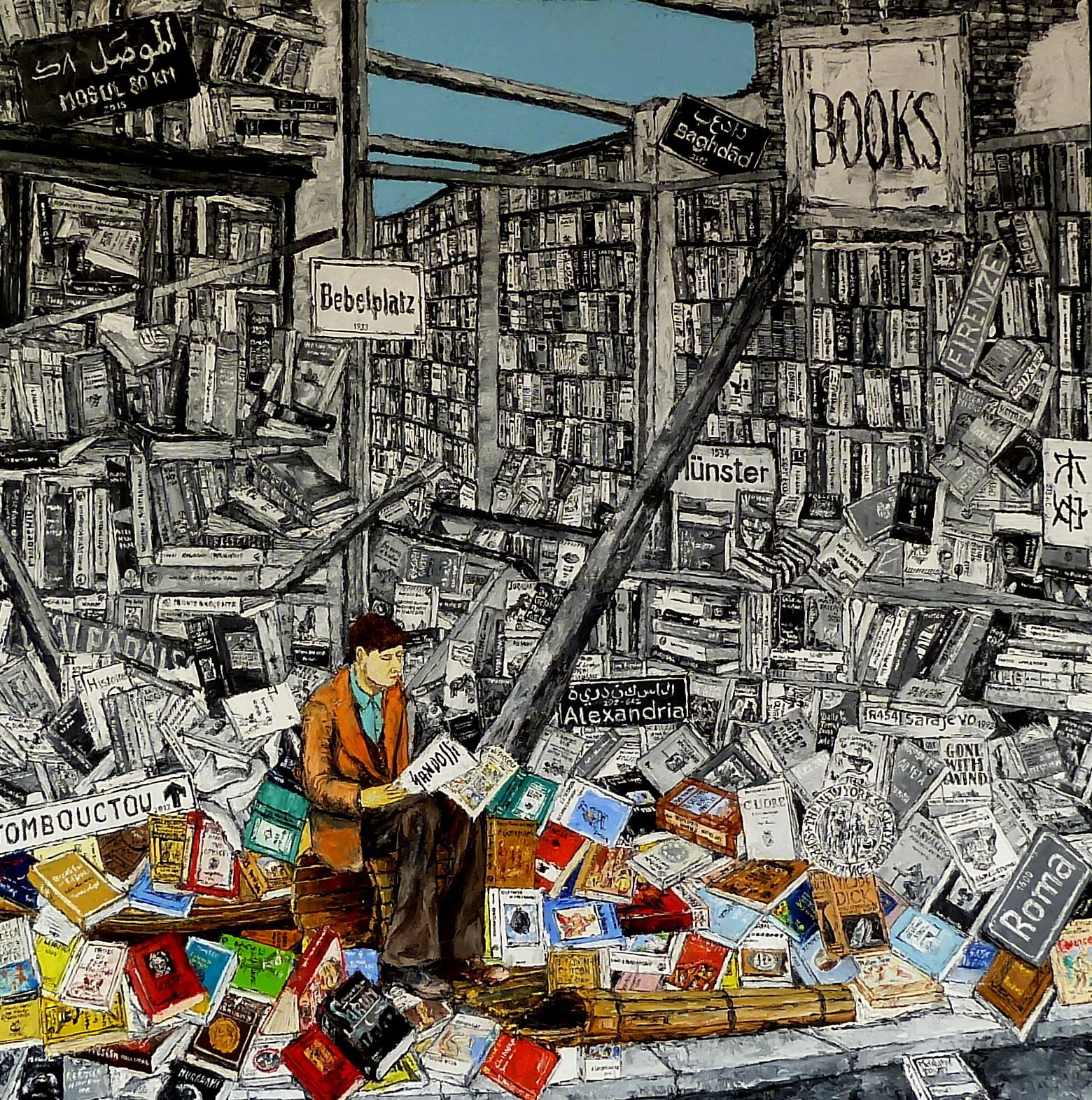
The title goes back to the film written and directed by Gary Ross in 1998. Its two protagonists, David and Jennifer, are thrown into the climate of stereotype, of normality, of conformism of the black-and-white sitcom Pleasantville, where life runs in black and white, a perfect town in which people live an utterly repetitive routine of habit – but for that very reason reassuring, and necessary to a utopically stable world where mishaps and evils are unknown. Only David's reading of books he knows well, and whose pages are blank, triggers the colouring of Pleasantville.
In the painting, the plaques giving places and dates are those where books were burned for political or religious reasons: power's attempt to destroy culture in order to subject people to a totalitarian regime. But culture cannot be destroyed... and so here is the boy who reads, and everything around him is in colour.
Book burning and the destruction of libraries were rather common practices in the past, often caused by war, by censorship or more simply by the need to erase information or ideas dangerous to the historical context in which they were carried out. These are some of the documented events:
The burning of books and the killing of scholars in the China of Qin Shi Huang in the year 212 BC; many intellectuals who disobeyed the order were buried alive.
The destruction of the works of Cremutius Cordus, one of the leading figures of Roman dissenting historiography, bent on exalting the vanished republican regime against the new imperial order held by the Julio-Claudian dynasty. He was charged with crimen maiestatis. His Annales were also accused of having criticised the people and the senate of Rome and of not having shown due respect towards Augustus and Caesar.[1]. The Senate decreed that all the books containing his work be burned by the Aediles.
The alchemy books of the encyclopaedia of Alexandria were burned in 292 by the emperor Diocletian.
Another famous act of destruction was the one carried out in the year 642 by the general Amr ibn al-As, commander of the Arab troops that had just conquered Egypt, who according to Abd al-Latif al-Baghdadi destroyed the Library of Alexandria and the books it contained on the orders of Caliph Umar. This was the caliph's reasoning: «In those books there are either things already present in the Koran, or things that are not part of the Koran: if they are present in the Koran they are useless; if they are not present, then they are harmful and must be destroyed». The sources, however, disagree on the date and the manner of the destruction of the library of Alexandria: it is possible that it was destroyed by a fire that was not intentional but accidental.
On 7 February 1497 an important burning of books and of artworks of considerable value, held to be immoral material, took place in Florence, known as the "Bonfire of the Vanities". It was promoted by Girolamo Savonarola.
In 1534, during the Münster rebellion (a German city in North Rhine-Westphalia), Anabaptist preachers declared Münster the New Zion and burned any book that was not the Bible.
The burning of the Maya and Aztec manuscripts in 1562, carried out by the Inquisition in Mexico on the orders of Diego de Landa[2], the Spanish Catholic bishop and scholar of Maya culture, known precisely for having destroyed almost the whole written cultural heritage of that civilisation. De Landa tried to gather as much information as he could about the very culture that, as an inquisitor, he had sought to make disappear at all costs.
At the beginning of the 16th century, the Andalusis of the Iberian peninsula were obliged to hand over to the Castilian authorities the books written in Arabic; those concerning medicine, philosophy and history were then returned to them, and all the others were burned[3].
- palette knife oil on canvas
- 90x90
- 2019